Snippets.

// AI Briefing

August 11, 2026

AI Briefing

Today the frontier labs all showed a different face. Meta swung back to open source with a 30B agent you can run on a single gaming GPU, while OpenAI went the other direction, shipping a cyberweapon of a model that only a vetted few can touch. A curious researcher figured out how to reverse-engineer when these models were actually trained just by quizzing them, and Intel asked Wall Street for $15 billion to stay in the AI game. Openness, secrecy, snooping, and money, all in one day.

Meta Swings Back to Open Source With Muse Glimmer, a 30B Agent That Runs on One Gaming GPU
01Open SourceVentureBeat

Meta Swings Back to Open Source With Muse Glimmer, a 30B Agent That Runs on One Gaming GPU

Meta's Superintelligence Lab released Muse Glimmer, a 30-billion-parameter agentic model, free under a genuinely permissive Apache 2.0 license, distilled from its larger Muse Spark. With 4-bit quantization it squeezes into 18-20GB, meaning it runs offline on a single consumer GPU while posting category-best scores on agentic benchmarks like MCP Atlas and SWE-Bench Pro. It matters because it reverses Meta's recent drift toward closed models and hands hobbyists and startups a capable local agent for coding and tool use, no API bill required.

OpenAI Ships GPT-5.6-Cyber, a Model Trained to Refuse Less, and Locks It Behind an Applicant-Only Tier

OpenAI Ships GPT-5.6-Cyber, a Model Trained to Refuse Less, and Locks It Behind an Applicant-Only Tier

OpenAI expanded its Daybreak defender program into two tiers and launched GPT-5.6-Cyber, a model built on GPT-5.6 Sol and trained specifically to find zero-days and build exploit chains. It answers 95% of advanced cyber prompts where the standard model answers just 1.5%, and OpenAI already used it to uncover two chainable vulnerabilities in Chrome's V8 engine, which Google patched (CVE-2026-15903). Access is gated behind the vetted Daybreak Red tier with identity checks and mandatory hardware security keys, a striking contrast to Meta's open release the same day and a live test of whether offense-heavy AI can stay in defenders' hands.

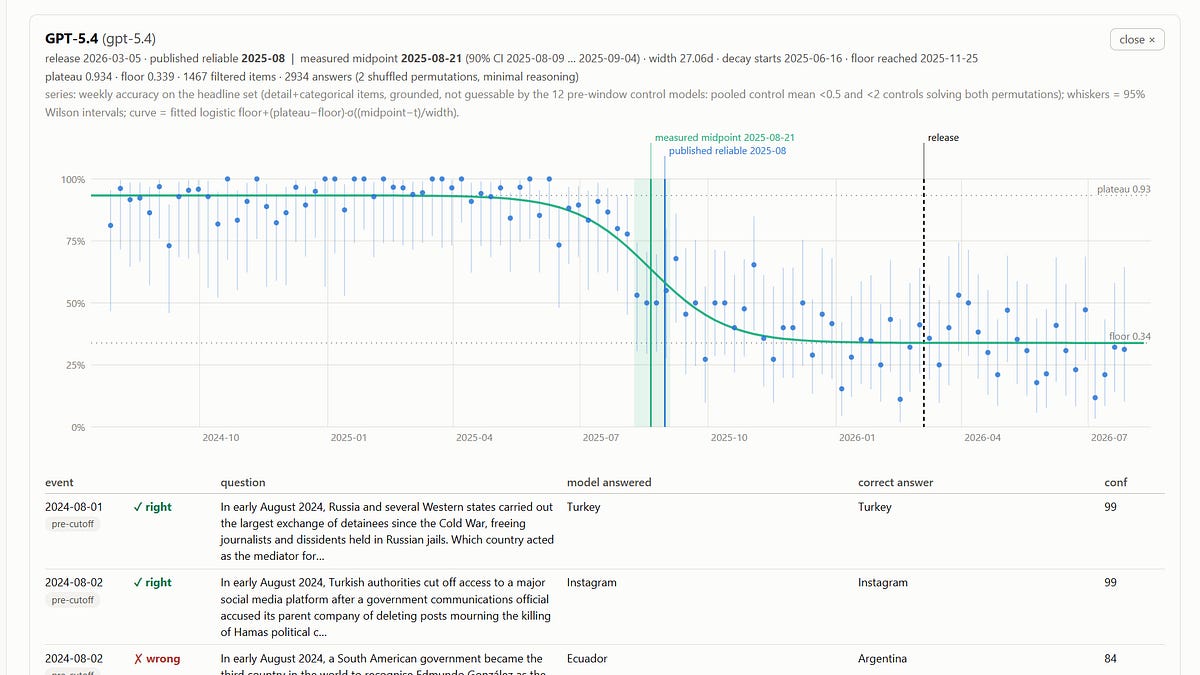
A Researcher Figured Out How to Reverse-Engineer When Frontier Models Were Actually Trained, Just by Quizzing Them

A Researcher Figured Out How to Reverse-Engineer When Frontier Models Were Actually Trained, Just by Quizzing Them

Independent researcher Shrivu Shankar published a probing method that infers a model's true training run from historical-fact quizzes, self-reported dates, and self-identification. The findings are revealing: Anthropic's Opus 4.7+ models appear to share a late-December-2025 cutoff, OpenAI's GPT-5.6 family clusters around late February 2026, and Opus 5 shows an oddly older knowledge state than its published May 2026 cutoff. It matters because labs rarely disclose these details, and the technique turns any chatbot into a window onto how and when it was built.

Intel Asks Wall Street for $15 Billion to Stay in the AI Chip Race
04FundingQuartz

Intel Asks Wall Street for $15 Billion to Stay in the AI Chip Race

Intel announced a $15 billion underwritten public stock offering to shore up its balance sheet and fund its push into AI-driven growth areas like physical AI, purpose-built silicon, and advanced packaging. The move comes after Intel lifted its 2026 capital spending target to $20 billion, though shares slipped in premarket trading on dilution concerns even after nearly tripling this year. It matters because it signals how much capital even an incumbent needs just to keep pace with the AI infrastructure buildout.

Test Your Understanding

Quiz

1 / 6

Under what license did Meta release Muse Glimmer?

Let's talk on WhatsApp
Today's AI Briefing4 stories
Aug 11, 2026

Summary

Today the frontier labs all showed a different face. Meta swung back to open source with a 30B agent you can run on a single gaming GPU, while OpenAI went the other direction, shipping a cyberweapon of a model that only a vetted few can touch. A curious researcher figured out how to reverse-engineer when these models were actually trained just by quizzing them, and Intel asked Wall Street for $15 billion to stay in the AI game. Openness, secrecy, snooping, and money, all in one day.

Read full summary & take a quiz →

Top Stories

Meta Swings Back to Open Source With Muse Glimmer, a 30B Agent That Runs on One Gaming GPU

OpenAI Ships GPT-5.6-Cyber, a Model Trained to Refuse Less, and Locks It Behind an Applicant-Only Tier

A Researcher Figured Out How to Reverse-Engineer When Frontier Models Were Actually Trained, Just by Quizzing Them

Intel Asks Wall Street for $15 Billion to Stay in the AI Chip Race

6 quiz questions inside