Yesterday was the day the money and the machinery both showed their hand. OpenAI's ad business hit a billion-dollar run rate in under 200 days, the Pentagon switched on ChatGPT and Grok for three million people, and Meta quietly revealed it has been training its recommendation models on its own silicon. Meanwhile Europe bought a €388M supercomputer with no Nvidia anywhere in it, and Anthropic finally let its browser agent click things without asking first.
ChatGPT Ads Went From Zero to a $1 Billion Run Rate in Under 200 Days
OpenAI announced that ChatGPT Ads has crossed $1 billion in annualized revenue run rate less than 200 days after launch, with tens of thousands of advertisers in 40+ countries and self-serve buying now opening across India, Europe, the Middle East and North Africa. The company frames advertising as the pillar that funds a free tier for more than a billion weekly users, which turns ads from a side experiment into structural infrastructure. It also puts OpenAI directly into the budget pool that currently funds Google and Meta.
The Pentagon Switched On ChatGPT and Grok for 3 Million People, and Claude Still Isn't Invited
Defense officials confirmed that OpenAI's ChatGPT Mil and Starshield AI's Grok for Government are now live on GenAI.mil alongside Google's Gemini, each cleared at Impact Level 5 for sensitive unclassified data. The platform has already onboarded 1.7 million of the department's roughly 3 million personnel, and ChatGPT Mil is aimed at document-heavy planning, policy, logistics and admin work. Anthropic's Claude remains conspicuously absent after the department branded it a supply-chain risk over Anthropic's refusal to drop mass-surveillance and lethal-autonomy guardrails, a designation a federal judge ruled illegal just last week.
Meta Built a Training Chip That Puts the Network Inside the Package
Meta detailed MTIA 300, its first in-house training accelerator, which embeds two network chiplets carrying twelve custom 800 Gbps RDMA NICs inside the chip package itself for 1.2 TB/s of I/O without ever crossing a PCIe bus. Sixteen dedicated message engines handle collective communication so it never competes with the compute grid: running collectives alongside large GEMMs costs under 0.5% throughput, versus more than 20% on conventional GPUs. On a 150-billion-parameter production recommendation model across 40 accelerators, communication time came in 3.9x faster than the equivalent GPU cluster, and the chip is already in production.
Google's New Forecasting Model Is 330M Parameters and Tops Three Benchmarks at Once
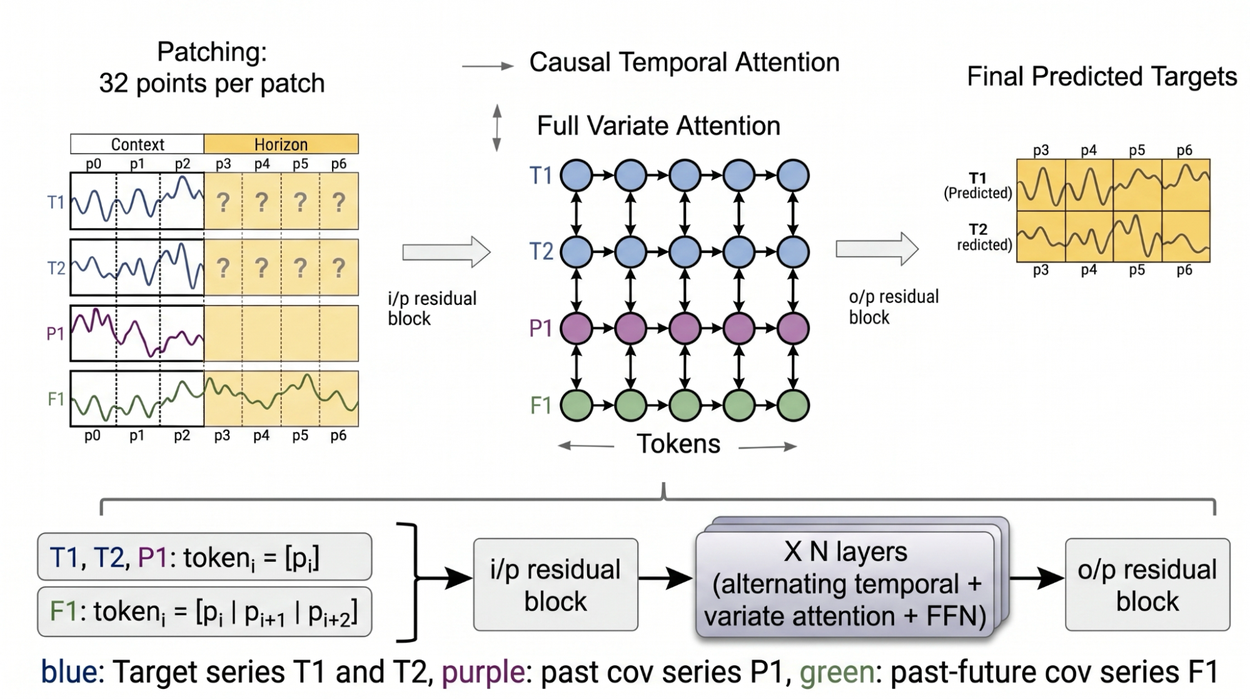
TimesFM-3 is a zero-shot time-series foundation model pre-trained on more than a trillion time points, and it is the first in the family to natively handle multivariate forecasting: several related series at once, past-only covariates, and known future events like promotions or holidays. It generates the entire forecast horizon in a single non-autoregressive pass, and ranks first among foundation models on GIFT-Eval, FEV-Bench and TIME for both point and probabilistic accuracy. Weights are already on GitHub and Hugging Face, with BigQuery integration landing shortly, which puts a state-of-the-art forecaster in reach of anyone with a laptop.
Anthropic Let Its Browser Agent Off the Leash After Driving Injection Attacks to Zero
Claude in Chrome is now generally available on every paid plan, and it can take actions autonomously rather than pausing for approval on each click, with a classifier checking every action against what you actually asked for. Anthropic published the underlying numbers: on its current red-teamer-sourced evaluation, attacks that reached the model succeeded 17.6% of the time against Opus 4.5 and 3.8% against Opus 5 with no safeguards at all. With probes plus the approval classifier running, no attack succeeded against Sonnet 5, Opus 5 or Mythos 5, and only 0.3% got through on Fable 5.
Europe Just Ordered a €388 Million AI Supercomputer With No Nvidia in It
EuroHPC signed a €387.8 million contract with Bull to build LUMI-AI at CSC's data centre in Kajaani, Finland, running AMD Instinct MI430X GPUs and 6th-gen 256-core AMD EPYC CPUs on Bull's liquid-cooled BullSequana XH3500 architecture, with IBM storage and Nokia networking. It targets roughly ten times the AI capacity of the current LUMI and lands in the second half of 2027, funded half by EuroHPC and half by a six-country consortium. It will sit beside IQM's LUMI-IQ quantum machine, run on 100% renewable power, and pipe its waste heat into Kajaani's district heating network.